![[object Object]](https://umsousercontent.com/lib_tLlsXzvLpXgGwMwW/4d5zuwob1ddstysx.png?w=260)
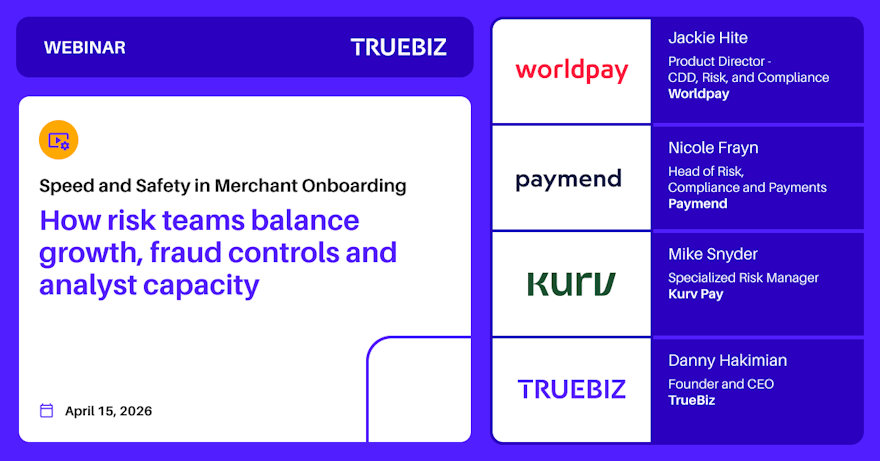
On April 15 2026, TrueBiz brought together three senior risk leaders to talk about one of the most persistent tensions in payments: how do you onboard merchants quickly without taking on unmanaged risk?
Here's what they said.
The panel:
Jackie Hite, Product Director for CDD, Risk and Compliance, Worldpay
Nicole Frayn, Head of Risk, Compliance and Payments, Paymend
Mike Snyder, Specialized Risk Manager, Kurv Pay
Danny Hakimian, CEO & Founder, TrueBiz
Watch the full on-demand webinar recording:
Where onboarding breaks
The panel was unanimous: friction most often enters the process before the underwriting team even begins.
Incomplete submissions, mismatched information, sales teams and risk teams working from different definitions of a good merchant. By the time an application reaches an analyst, the damage is already done.
"If sales and risk aren't aligned on what a good merchant looks like, then onboarding will always break," said Nicole. "Uncompleted underwriting packages, unclear billing models, mismatched URLs. That's a big friction point for us."
Jackie pointed to the data quality problem: "It doesn't matter how good your tools are if the information coming in is dirty or wrong. That can make it hard for the teams, because it'll kick out for manual review."
The knock-on effect: analysts stop underwriting and start investigating.
"When you have unclear and inconsistent merchant data, the analysts aren't just underwriting, they're acting as investigators," said Nicole. Mike agreed: "Most of the time is spent trying to figure out if this is a legitimate merchant or not. And once you figure that out, then you can really start underwriting."
The hardest cases to verify: startups under three months old, and online-only merchants with no web presence. Jackie described one pattern her team encounters regularly: merchants claiming to sell one thing, but whose social media, link history, and site metadata tell a different story entirely. "You could spend two, three hours digging into all of this information." That's where automation starts to earn its place.

What to automate, and what not to
Jackie described Worldpay's approach: "I don't want to see the easy deals, and I don't want to see the bad deals," said Jackie. "Ideally it auto-approves everything that's clean and auto-declines everything we know is prohibited. And then our sweet spot is the ones we actually have to work on."
One concrete example: Worldpay introduced liveness and identity verification checks for a channel that was seeing around 40% fraudulent submissions. "That knocked their fraud submissions down almost to zero overnight."
For the cases that don't auto-resolve, digital footprint intelligence is what makes fast decisions possible. Mike's team now flags routinely: merchants with Shopify processing history but zero web traffic. "That's a little suspicious. I'm going to have to ask some questions about that." Jackie pointed to link analysis for catching fraud rings: multiple businesses, different names, cycling through domains. "They'll shut down one website, they'll open up another." Catching that manually takes hours. Automatically, in seconds.
Jackie's rule: every automated output has to be auditable. "It has to provide a trail of where you get the information." Her team weights data by source reliability, IRS database signals carry more weight than a Google result, and adjusts accordingly.
Nicole put the economics plainly: "Everything costs money. Every merchant you underwrite has a cost attached to it. You can end up with really expensive onboarding processes that don't actually improve your decisions if you're not adapting to those decisions."
Triage is more important than automation
Nicole spoke on how to design a scalable risk operation: "If your queue is wrong, then everything downstream is inefficient."
Her approach to building a scalable risk team:
Segment merchants into tiers by risk level, MCC, billing model, and sales channel
Route work by skill level: junior analysts on low-risk structured deals, senior analysts on complex or high-exposure verticals
Kill bad submissions early: enforce minimum data requirements before anything reaches the queue
"A lot of the triage problems are actually intake problems"
Mike reinforced the value of specialisation: "If I'm always looking at e-commerce nutraceutical merchants, I can pick up on trends. I can make decisions faster."
Jackie added the commercial dimension. Analysts should focus energy where it generates revenue, not just where fraud is loudest. "You don't want to spend a ton of time on accounts that are not going to be profitable for you, even if they're fun to look at."
The panel's consensus on the underwriter role going forward: it's shifting from manual reviewer to synthesiser. More vendors, more data signals, more automated outputs all feeding into a decision that still requires human judgment to finalize.
"Now I have all these people giving me inputs," said Jackie. "I then have to take all that and make my own decision. That's what's changed a lot for me."

The takeaways
Risk and compliance teams aren't being asked to choose between speed and safety. They're being asked to design systems that deliver both - and that requires being intentional about where automation adds value, where human judgment is irreplaceable, and how work gets routed in the first place.
From the panel:
Friction is a design problem, not a volume problem. Most of it enters before the analyst even sees the case.
Automate the clear decisions. Triage the rest. High-performing teams optimize for decision quality, not automation rate.
The underwriter role is evolving. Less manual data gathering, more signal synthesis and judgment on the cases that actually matter.
Want to see how TrueBiz helps risk teams cut manual review time and catch more risk at onboarding? Book a demo at truebiz.io