![[object Object]](https://umsousercontent.com/lib_tLlsXzvLpXgGwMwW/4d5zuwob1ddstysx.png?w=260)
Several merchant applications looked clean in isolation. A connected-entity view told a different story.
AT A GLANCE
Nexio is a US ISO over 10 years in business, built around complex risk.
The problem: manual legitimacy reviews causing time wastage and low confidence; polished websites hiding shaky businesses; separate applications nobody could see were a connected fraud ring.
The result: with TrueBiz they got reasoned, defensible decisions on every deal and a powerful tool for exposing fraud rings.
THE CHALLENGE
Manual merchant review creates competitive risk
The biggest thing Chad Nielson, Chief Risk Officer at Nexio, is trying to solve is friction, or what he calls 'calories'. Every application coming through Nexio's network of third-party agents should reach an approval or decline with as few back-and-forth requests as possible. The pend rate, Nexio's core measure of that friction, sits alongside a four-hour SLA to respond to every application. In a business where competing acquirers are often racing for the same deal, cutting calories drives competitive edge, not just efficiency.
Before TrueBiz, web-presence and business-legitimacy reviews were mostly manual. Alice Dassau, VP Underwriting, shared that analysts spent most of that time on open-web research, “chasing down whether a business was actually operating, whether the website matched the stated business model, and whether the entity and address held up”.
The real difficulty was telling apart a polished but thin web presence, where the site looked legitimate but the story underneath didn't hold together, from a business that looked shakier on the surface but still deserved real evidence before a decline.
What Alice and her team needed most wasn't just decision speed. It was a result they could act on with clear and transparent reasoning attached, so an underwriter could stand behind a decision instead of trusting a score they couldn’t explain.
THE SOLUTION
AI assessment underwriters can trust
Alice and her team sat through more vendor demos than she can count. The requirement stayed consistent throughout: "an AI-driven approach to underwriting. We needed a way to assess a merchant's web footprint that was faster, repeatable, and defensible, with real reasoning behind it".
TrueBiz stood out in three ways, Alice says: "The breadth of signals pulled from a merchant's web presence; the speed of a full assessment; and structured, reason-coded output instead of a raw dump of pages to interpret".
Implementation was largely out-of-the-box. TrueBiz slotted in as one of Nexio's standard underwriting reports, running on every deal alongside checks like credit. The team picked it up fast because the output was intuitive and needed little training.
The clearest sign it was working? "When our salespeople started using it as a pre-vet tool rather than submitting everything and hoping something would stick".
THE IMPACT
Fraud rings and complex risk exposed
The fraud ring hiding in plain sight
Alice points to one example where TrueBiz surfaced something her team would likely have missed entirely, and gave them far greater confidence in a difficult decision.
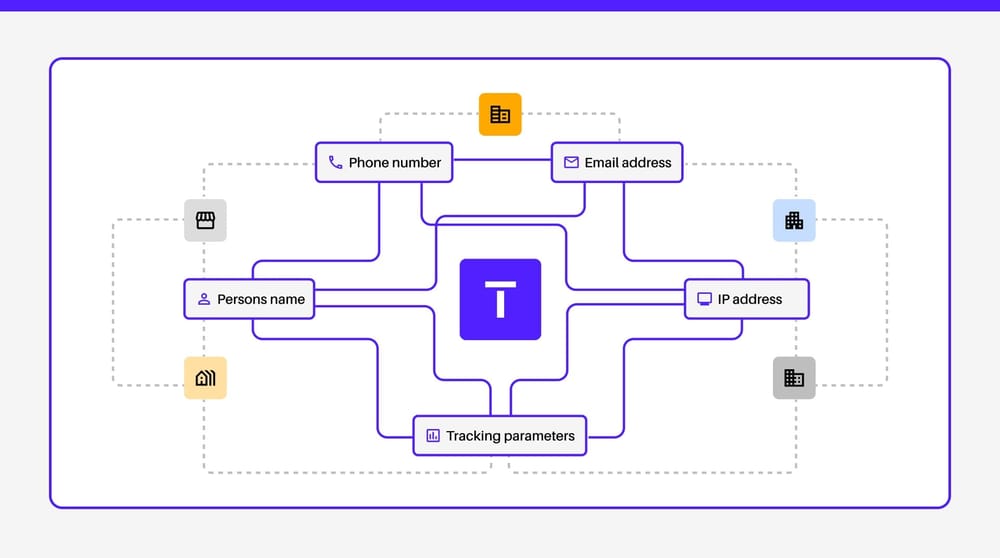
Several applications came in separately, each looking fine on its own:
"TrueBiz surfaced shared connections between them: common principals, addresses, and infrastructure, that tied them into the same fraud ring. On their own we might well have boarded at least one before the pattern became obvious. Instead we identified the linkage and declined the whole cluster upfront. That connected-entity view is something manual review almost never catches in time".
A coherence check for complex risk
In verticals like negative-option and travel, what typically exposes shell-style or misrepresented operations is address validation, registered-agent and PO-box detection, and physical-location and connected-entity checks. But above any one of these signals, it's the overall "coherence check", as Alice calls it, that brings the greatest value:
"TrueBiz weaves the website, reviews, traffic, locations, and connected entities into one picture, so we can see whether a merchant's story is internally consistent. On complex deals, a polished site hiding an incoherent underlying business is the exact pattern we care about, and that holistic view surfaces it".
Reasoning underwriters can defend
For underwriters working across a wide, third-party agent network, having the same starting point on every deal matters.
It's something they can point to if a decision is ever questioned, by a partner bank, a card network, or a merchant themselves. Alice describes what changed for her team:
"The biggest change is that analysts have greater confidence. When a merchant passes TrueBiz, we know a broad set of signals was checked the same way every time. When it fails or flags, the reasoning is right there to act on".
A structured input for Nexio's own AI
TrueBiz now feeds CHIP, Nexio's AI underwriting agent, as one of its standardized reports. It works well as an AI input because the output is structured and machine-readable rather than requiring interpretation of raw web pages. And since TrueBiz is configured to Nexio's own risk preferences, its pass/fail already aligns with how Nexio underwrites, making it decision-relevant and consistent.
Nexio is continuing to build out its AI-native workflow, and exploring new use cases combining TrueBiz with other data sources to build toward a 'junior underwriter': a system that can auto-approve when confident and flag exactly what needs human review when it's not.
Find the connections individual merchant reviews miss. Request a demo.